
When the news starts moving: How GIF thumbnails are reshaping online journalism
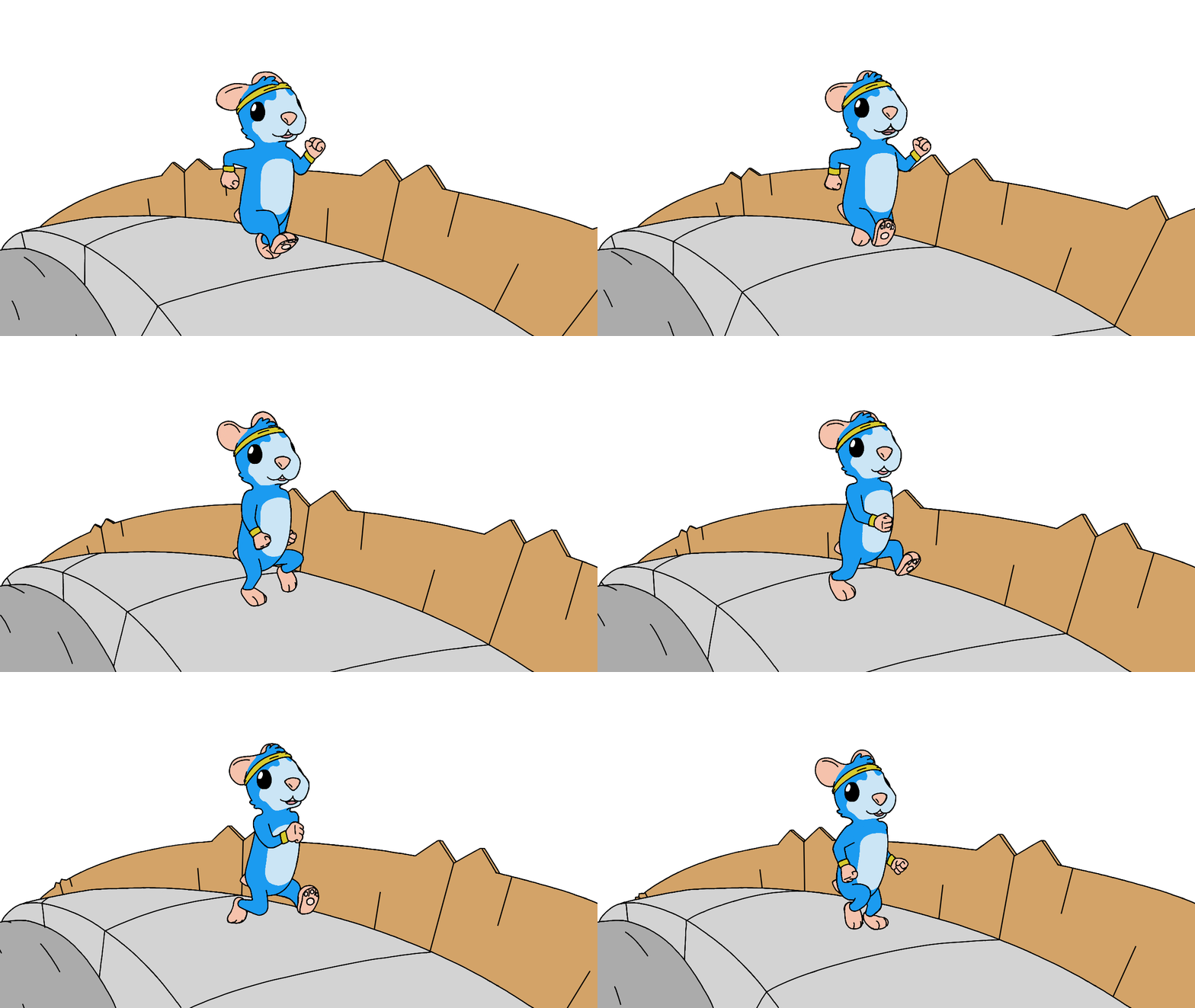
Scroll through the homepage of some modern news websites, and one thing quickly becomes clear: the news no longer stands still.
Animated GIFs—short, silent, looping images—are increasingly used as thumbnails on news homepages and apps, replacing or supplementing traditional photographs. Once confined to memes and reaction culture, GIFs have become a serious visual tool in digital journalism, used to signal urgency, drama, and importance before a reader even clicks.
Recent academic research by media scholar Sara Kopelman shows that this shift is not accidental or superficial. Instead, it reflects a deeper transformation in how journalism adapts to smartphone use, social media logic, and the attention economy.
From decisive moment to decisive movement
For more than a century, photojournalism has been built around what Henri Cartier-Bresson famously called the “decisive moment”: a single still image that freezes an event and invites the viewer to imagine its wider story. Video journalism, by contrast, offers a linear sequence with sound, duration, and narrative closure.
The GIF occupies an unusual middle ground. It is silent like a photograph, moving like a video, but defined by one distinctive feature: endless repetition. A GIF does not begin or end. It shows a moment again and again.
Kopelman argues that this has created a new visual logic in journalism: a shift from the decisive moment to what she terms the “decisive movement”. Instead of selecting one frozen frame, editors select a short movement that captures what they believe is the essence of the story—a crowd surging forward, a suspect fleeing, a bridge swaying just before collapse.
As homepage thumbnails, GIFs tell readers not just what happened, but where to look.
Designed for scrolling, built for attention
The rise of GIF thumbnails cannot be separated from how audiences now encounter news. Smartphones have become the primary news device, and social media platforms have shaped expectations around speed, movement, and immediacy.
In this environment, static images are easy to ignore. Movement, however, interrupts the scroll.





Editors interviewed in Kopelman’s studies repeatedly describe GIFs as “eye-catchers”—a lightweight way to attract attention without the technical and financial costs of autoplay video. A GIF loads quickly, plays silently, and instantly signals that something is happening.
In practical terms, GIF thumbnails function as:
- Visual teasers for full articles or videos
- A form of click-inducing headline image
- A way to make a homepage feel “alive” rather than static
For readers who never click through, the GIF itself often becomes the primary encounter with the story.
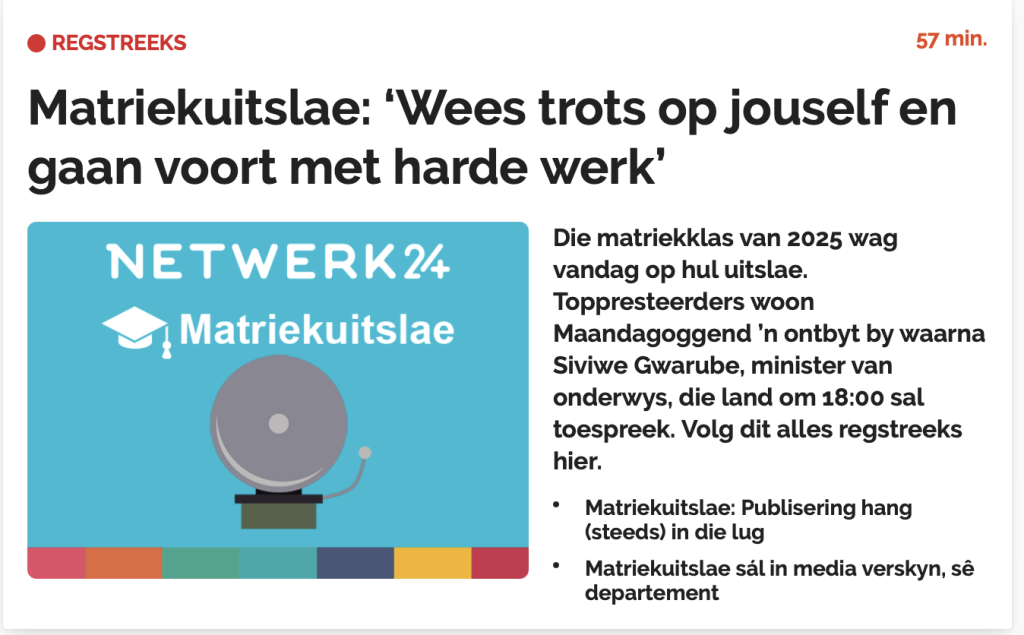
An example of how GIFs are used is Netwerk24. On their homepage, they entice you to stop scrolling at the video section of their website. This also visually tells you that you can view this video.
They also show off where you can view the matric results with a GIF icon.

Not just clickbait: GIFs as storytelling tools
While GIFs clearly serve an attention-grabbing role, the research shows that editors do not see them as mere gimmicks. Instead, many describe GIFs as a compressed storytelling format—a visual equivalent of a soundbite.
A successful news GIF, according to editors, must:
- Clearly show what is happening without explanation
- Loop smoothly without disorienting jump cuts
- Contain movement that is essential to the story
In this sense, GIF thumbnails are not decorative. They editorialise. They highlight what matters most and frame how readers interpret the event before reading a single word.
The surprising rise of tragic GIFs
One of the most striking findings across both studies is the significant use of GIFs for conveying negative and tragic news. Despite their cultural association with humour, GIFs increasingly accompany stories about violence, disasters, accidents, and crime.
Editors justify this practice by drawing boundaries:
- GIFs are cut before showing death or extreme injury
- Blood and corpses are avoided
- The focus is on action, not aftermath
Yet the format itself introduces a new ethical tension. Because GIFs loop endlessly, they can trap viewers in a moment of crisis, forcing repeated exposure without resolution.
Unlike video, which eventually ends, or a photograph, which allows the viewer to pause, the GIF suspends the story in a permanent present. Kopelman argues that this can intensify emotional impact and even distress, especially when applied to tragic events.
Repetition, trauma and responsibility
This endless repetition echoes older broadcast practices, such as television “disaster marathons,” where limited footage is shown repeatedly during breaking news. But there is a crucial difference: television eventually moves on. The GIF does not.
As homepage thumbnails, tragic GIFs can become permanent spectacles, replaying moments of danger or fear every time a user opens an app. This raises difficult questions about audience consent, emotional well-being and the line between informing and sensationalising.
The issue becomes even more complex when GIF creation is automated. One newsroom studied by Kopelman uses algorithms to generate GIFs based on user engagement, reducing human editorial oversight and shifting ethical responsibility away from editors.
A format that reflects the moment
Taken together, the research shows that GIF thumbnails are not a passing trend. They reflect how journalism is being reshaped by:
- Endless scrolling interfaces
- Competition for attention
- Mobile-first consumption
- Platform-driven visual norms
GIFs compress time, intensify movement, and prioritise immediacy. They fit the rhythms of contemporary news use—but they also challenge long-standing journalistic values around context, reflection, and restraint.
As news increasingly moves, the central question is no longer whether GIFs belong on homepages, but how far they should go—and what responsibility comes with making tragedy loop forever.
Sources:
Cover gif: Pixabay.com
Kopelman, S. 2025. “The Insistent image: The photojournalistic GIF as a storytelling form in online news”. Journalism Studies. 26:15, 1871-1891, DOI:10.1080/1461670X.2025.2540448
Kopelman, S. 2024. “The photojournalistic GIF: Visual journalism in the social media era.” The 25th Annual Conference of the Association of Internet Researchers, Sheffield, UK / 30 Oct – 2 Nov 2024.
Selected Papers of #AoIR2024